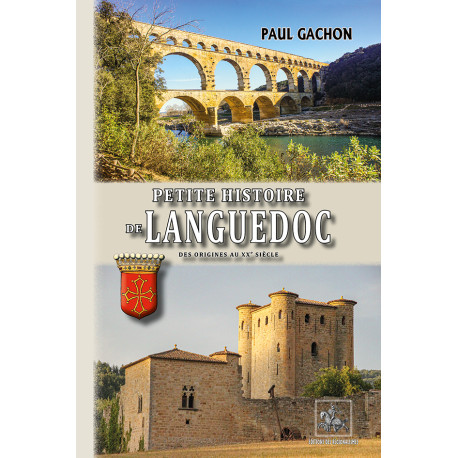


Petite histoire du Languedoc, des origines au XXe siècle - Paul GACHON. Short history of Languedoc, from its origins to the 20th century. In spite of the disproportion between the extent of the administrative district and that of the dialectal domain from which it took its name, the historical Languedoc remained the largest province of ancient France. Editions des Régionalismes.
 Security policy
(edit with the Customer Reassurance module)
 Delivery policy
(edit with the Customer Reassurance module)
 Return policy
(edit with the Customer Reassurance module)
Petite histoire du Languedoc, des origines au XXe siècle - Paul GACHON
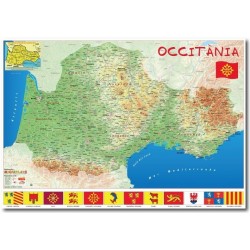
In the area of the Languedocian language, the province of Languedoc, at first glance, appears as an arbitrary division. The limits of the languages of oïl and oc leave to the use of the latter all the territory included between the Pyrenees, the Mediterranean littoral up to the Var, except the Basque enclave, and a line which, starting from the Verdon, on the right bank of the Gironde, goes up north of Libourne to Confolens and Guéret, to incline southward down to Valence and, following roughly the northern confines of the two departments of Drôme and Hautes-Alpes, ends at the Italian border.
There the old province of Languedoc occupied an area of only about 41,500 km², including most of the present department of Haute-Garonne, the whole of Tarn, part of Ariège and Pyrénées-Orientales, Aude, Hérault, Gard, Lozère, most of Ardèche and Haute-Loire. In spite of this disproportion between the extent of the administrative district and that of the dialectal domain from which it drew its name, the historical Languedoc remained the vastest province of old France after Guyenne and Gascogne combined. It was perhaps the most complex...
A new edition, entirely recomposed, with new color illustrations, which takes up the original text of the 1921 edition.
Collection Arremoludas, editions of Regionalisms.
The author:
Paul Gachon (1854-1929), born in Sauve (Gard), professor of history, dean of the faculty of letters of Montpellier. He was also a general councilor of the Gard department.
Data sheet
Specific References
Petite histoire du Languedoc, des origines au XXe siècle - Paul GACHON. Short history of Languedoc, from its origins to the 20th century. In spite of the disproportion between the extent of the administrative district and that of the dialectal domain from which it took its name, the historical Languedoc remained the largest province of ancient France. Editions des Régionalismes.